Emma's Journey with Dissociative Identity Disorder
IMG_6643.png

BLOG

Internal and External "Walls"

In the episode about Integration and Differentiation, the article that Dr. E found and was sharing is this one:, along with the “pie charts” she referenced during the podcast:

IMG_8813.jpg

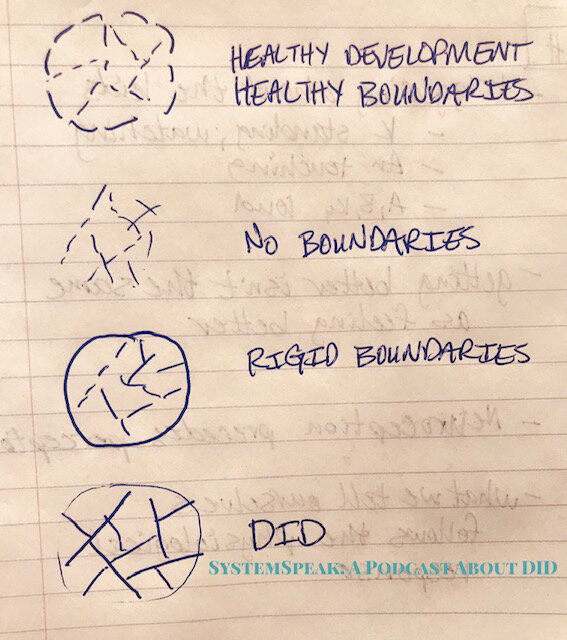
The drawings that our very first therapist did ages ago were something like this, in explaining internal and external walls, and what is helpful and healthy and what makes things more challenging once a survivor is out of danger:

IMG_8814.jpg
Dongles

In the “Fish Tank” episode, the Husband shared about his experience with EMDR. He talked about having headphones he listens to, and small paddles or “dongles” that he holds one of in each hand. He said that he hears beeps and feels vibrations on alternating sides as part of the experience. He talked about the family therapist having a box where she could adjust the speed or other settings of those beeps and vibrations as needed.

In response to this episode, a friend shared a picture of one kind of these devices, though there are different kinds and different ways of doing EMDR with the different tools. This is just one example, and very similar to what the husband was describing.

While he found it particularly useful for his depression, the device itself may be triggering to some survivors of certain kinds of organized or ritual abuse. Some clinicians use a light bar of colored lights instead of this kind of device, which may be triggering to survivors of pornography or traffficking type settings. In addition, EMDR does not help everyone with everything, and we have been told by many survivors and clinicians alike that timing and containment of some sort is critical to a positive experience with EMDR.

That said, many survivors who have used EMDR in safe ways with good clinicians when they are ready for it as an intervention, describe very positive experiences and good results.

This podcast episode was not about EMDR or when to use it or who should or not, but simply about the husband’s experience of it while being treated for depression. The picture is provided simply for those who wanted to see to be able to understand what he was talking about with the “dongles”.

You can listen to other episodes about EMDR specifically to learn more about it, or check out their website HERE.

IMG_8818.jpg
TreatmentEmma SunshawEMDR
Guest: Pam Stavropoulos, PhD (Blue Knot Foundation)

Pam Stavropoulos, PhD

pam 1.jpg

We welcome Pam Stavropoulos, PhD (Politics), Grad. Dip. Psychotherapy to the podcast to share about her research work with complex trauma at Blue Knot Foundation.

Specifically, she shares with us about the recently released 2019 updated Practice Guidelines for the Treatment of Complex Trauma, which you can read HERE. It is available for download for free, with permission to share.

In the podcast, she shares about the research behind the updated guidelines, and also mentions therapist compentancies, which you can read HERE.

A list of selected publications can be viewed HERE.

Guest: Richard Chefetz, MD
chefetz.jpg

Dr. Chefetz is a psychiatrist in private practice in Washington, D.C.

He was President of the International Society for the Study of Trauma and Dissociation (ISSTD) from 2002-2003, and is a Distinguished Visiting Lecturer at the William Alanson White Institute of Psychiatry, Psychoanalysis, and Psychology. He is a faculty member at the Washington School of Psychiatry, the Institute of Contemporary Psychotherapy & Psychoanalysis, and the Washington Baltimore Center for Psychoanalysis. . He is a Certified Consultant at the American Society of Clinical Hypnosis and is trained in Level I and II EMDR.

Dr. Chefetz was editor of “Dissociative Disorders: An Expanding Window into the Psychobiology of Mind” for the Psychiatric Clinics of North America, March 2006, “Neuroscientific and Therapeutic Advances in Dissociative Disorders,” Psychiatric Annals, August 2005, and “Multimodal Treatment of Complex Dissociative Disorders,” Psychoanalytic Inquiry, 20:2, 2000, as well as numerous journal articles on psychodynamic and psychoanalytic perspectives on trauma and dissociation. In 2015 he published Intensive Psychotherapy for Persistent Dissociative Process: The Fear of Feeling Real, with W.W. Norton, in their Interpersonal Neurobiology series.

His website is HERE.

Guest: Cathy Kezelman, MD (Blue Knot Foundation)
010312-01712.jpg

Dr. Cathy Kezelman AM is a medical practitioner, mental health consumer advocate, President of Blue Knot Foundation National Centre of Excellence for Complex Trauma. She is a current member of NSW Child Safety Standing Committee for Survivor and Faith Groups. She is past director of the Mental Health Coordinating Council (MHCC), past member of the Mental Health Community Advisory Council (NSW) foundation member of the national Trauma Informed Care and Practice Advisory working Group, member of Independent Advisory Council on Redress. 

Cathy worked in medical practice for 20 years, mostly as a GP. Under her stewardship Blue Knot Foundation has grown from a peer support organisation to a national centre of excellence combining a prominent consumer voice with that of researchers, academics and clinicians advocating for socio-political trauma-informed change and informed responsiveness to complex trauma. She is a prominent voice in the media and at conferences, as well as author of a memoir chronicling her journey of recovery from child sexual abuse: Innocence Revisited - a tale in parts. She is co-author of multiple seminal Blue Knot Foundation documents including 2019 Practice Guidelines for Clinical Treatment of Complex Trauma. 

41aigP6SoqL._SX327_BO1,204,203,200_.jpg

Blue Knot Foundation is Australia’s National Centre of Excellence for Complex Trauma. It empowers recovery and builds resilience for the more than five million (1 in 4) adult Australians with a lived experience of complex trauma. This includes those experiencing repeated ongoing interpersonal trauma and abuse, often from childhood, as an adult, or both as well as their families and communities.

Formed in 1995, Blue Knot Foundation is at the forefront of pioneering trauma-informed policy, practice, training and research. It provides direct services to survivors: specialist trauma phone counselling and educational workshops for survivors and their family members, partners and loved ones as well as an extensive professional training program for workers, professionals and organisations from diverse sectors supported by supervision and consultancy services. It also has extensive resources including fact sheets, videos, publications and website information at www.blueknot.org.au

It has launched new 2019 updated Practice Guidelines for Clinical Treatment of Complex Trauma. Co-authored by Dr Cathy Kezelman AM, President and Pam Stavropoulos PhD, Head of Research these clinical guidelines update the 2012 internationally acclaimed and extensively endorsed Practice Guidelines for Treatment of Complex Trauma and Trauma Informed Care and Service Delivery. Evolving research and clinical insights, as well as the continuing challenges of treating people with a lived experience of `complex’ trauma, mean that the original 2012 Blue Knot guidelines, still a valuable resource for students or clinicians new to this work, have required updating.

 The 2019 guidelines have also been extensively endorsed by leading academics, clinicians and researchers in the complex trauma and dissociation field prior to their release, including by the peak international body – International Society for the Study of Trauma & Dissociation (ISSTD). The new guidelines provide an integrative guide for diverse practitioners working with complex trauma and dissociative clients.

In addition a companion guide to the 2019 Guidelines – combined Complementary Guidelines which provide an overview of the differences between working with complex trauma clients and standard counselling approaches as well as a guide to therapist competencies for working with complex trauma and dissociation have also been released.

 Hard copies and free downloads of each publication are available from Blue Knot’s Practice Guidelines portal. We have endorsed the guidelines and encourage you to explore them!

Emma Sunshaw
Structural Dissociation Discussion

This week on the podcast, we discussed an article published by Sarah Clark of the Stronghold System on their website, PowerToThePlurals.com, and shared in her facebook support group AlterNation.

Their article discusses the Theory of Structural Dissociation.

In the article, they consider it to almost be a theory of structural integration instead, and call the theory out for being ableist due to it emphasis on functioning through one ANP in therapy rather than whoever presents, and because of the emphasis on integration as the only treatment option. As they said in the podcast interview, the theory of structural dissociation is being used to push integration as the only option “because it sets up the idea we were never “split off” in the first place, so it’s easier to integrate us back to together again”. Here’s the quote from their article that they reference in the podcast:

We read in the same book (page 7) ‘’Structural dissociation involves hindrance or breakdown of a natural progression toward integration of psychobiological systems of the personality that have been described as discrete behavioral states.’’ (Putnam, 1997).

This is what most people refer to when explaining that we are not broken, not split off. We are all born with different states and early childhood trauma survivors can’t integrate in early childhood due to that trauma. But as you can see it was actually Putnam in 1997 who introduced this idea.

They also say that the authors of the theory appropriated or borrowed terms from other authors who used them much earlier. Here’s a quote from their article:

Charles Samual Myers, who in 1916 wrote about Apparently Normal Part (ANP) and Emotional Part (EP) after acute trauma in WW1. So it is fair to say that the theory of Structural dissociation borrowed these terms, not introduced them, as is readable in the haunted self. (page 4)

Drawing conclusions from this, they clarify that you can accept parts of the theory from the original authors, rather than crediting this theory for your understanding.

They go on to say that the Theory of Structural Dissociation is a model about trauma, not a model about dissociation. Here’s the quote from the article:

It is also good to realize that the theory of Structural dissociation is neither about DID, nor is it about alters, as many of us Plurals know them. They speak of ‘dissociative parts of the personality’, caused by trauma. Nota bene, not early childhood trauma, trauma in general. As this theory also explains single trauma, repeated trauma in adulthood and (early) childhood trauma. It is used to describe changes that are diagnosed as (c)PTSD, trauma related borderline personality disorder, DID and more.

This, along with their perspective that because of DSM5 criteria, DID does not actually have to be a “disorder” if the person’s System is not distressed by it and functioning well. From this, they issue a call to the community to refer to themselves as “Plural” culturally, rather than DID therapeutically. They also are calling for “Functional Multiplicty” to be an option in treatment, rather than integration pushed as the goal.

This, they say, is more effective for positive cooperation amongst a system and healthy functioning as a system, with greater participation in therapy than what the Theory of Structural Dissociation offers. They say:

The theory of Structural dissociation idolizes integration. And although they say that ‘’no one has to go away’’, they also clearly explain to therapists, to not engage with us ‘dissociative parts of the personality,’ unless absolutely needed. Instead it is suggested that the therapist speaks whenever possible, through the ANP fronting…

… And in DID, in particular, requiring all communications to relay through one particular (perhaps malleable or favored) ‘alter’ that sounds a lot like silencing to me. Because the therapist (or any other outside person,) can never know (for sure) whether the part who is presenting, is truly conveying all information which is coming from inside. This book talks a lot about shame, but forgets that our ANPs might not feel comfortable repeating what those EPs just said inside, and that the information may be so overwhelming for them as to cause them to have intense dissociative symptoms.

You can see in the article that they use a picture of a slide from a presentation by Kathy Steele to show that the Theory of Structural Dissociation is being taught to only talk to one ANP and focus on integration in that way.

Following this perspective and logic, they conclude in their article, that the Theory of Structural Dissociation is ableist:

We know from a 6 year follow up study that only 12.8% of participants were able to reach integration as described in the theory of Structural dissociation. (page 4 )

That is a very low percentage. In any scientific research for medicine or therapy for example, a 12.8% positive outcome would not be tolerable. Yet the whole theory of treatment within Structural dissociation is based on it.

A chronic disorder, often debilitating, with a much-respected and idolized healing option with only 12.8% success rate, sounds ableist to me.

A 12% success rate is definitely a call for improved access to and quality in treatment, absolutely, and worth talking about - that’s why we shared it on the podcast.

That said, I don’t know how someone would pin-point integration on a timeline, when to us it feels more like a process than an event (Dr. Siegel said this on our podcast!) - so that 12% seems interesting to qualify with things like how they defined integration and what kind of follow-up support they received and who continued maintenance therapy or not and what kind of life stressors they had and those kinds of questions.

However, there is more to this piece we need to look at to see everything. This study mentioned is one of Bethany Brand’s from Top DD Studies, and I interviewed her earlier for the podcast last summer - unfortunately, it was one of the lost episodes because of technology glitches. But what I know from this study is that it does give a 12% success rate for integration, but it also mentions ANOTHER 12% who are “successful” without integration in a final-fusion kind of way. Further, the study also emphasizes other ways success can be measured and were noticed in the study, including: reduced hospitalizations, reduced suicide attempts, and improved GAF (global assessment of functioning) scores. These are significant and worth mentioning.

But, following this discussion on the podcast, Dr. Peter Barach reached out to us (as a friend and colleague, not in any clinical role) in response with more information. He also clarified that:

I think she has some incorrect ideas about what is generally recommended these days as treatment for DID. I think if you take a look at the ISSTD treatment guidelines, you won’t find what she says to be there. The term “integration” refers to “better integrated functioning ,” not to “fusion” of all the alters I to one.

Kluft argues that fusion leads to the most stable outcome of treatment—that’s his opinion, but the only data on that point comes from a series of people he treated himself. Fusion doesn’t always happen, and it’s also clear that some people with DID don’t want it.

He also shared further insights that we shared in the episode “Clinical Response” in the episode following the interview with the Stronghold System. Here is some of what he clarified in response:

Charles Myers wrote a book (1940) describing veterans of World War I in France who had shell shock, which of course is now called PTSD. He said that there are "emotional" personalities, referring to behavior during flashbacks and trauma-related nightmares, and "apparently normal" personalities who are detached from the experiences of reliving trauma.

I think he used the term "personality" in a much looser sense than we think of parts or alters, whatever word we use, in DID. He was not talking about survivors of childhood trauma.

Myers was not talking about parts or alters with different names and ages. An example of this is a veteran with PTSD working as an auto mechanic who hits the ground when there is a loud noise at work, such as a tire popping suddenly off its rim. This is an automatic response without thinking or planning, and leaves the veteran feeling embarrassed.

Here Dr. Barach clarifies that Myers was not talking about DID, but about a PTSD kind of response. In a plural system, the ANP and EP are distinct personalities as in parts or alters, as in distinguished by identity (age, gender, name, etc.), whereas what Myers was referring to was functioning - the veteran being able to function in a work setting upon returning from war (ANP), but having a limbic response triggered (EP). When Van der Hart uses the terms ANP and EP, he is applying them in an extended way to explain the continuum of dissociation.

Further, Dr. Barach points out that Van der Hart does give Myers credit when using the ANP and EP terminology, so it is neither appropriated or used without acknowledging the source.

Van der Hart always mentions Myers when he uses those terms ANP and EP, so I disagree that he and his coauthors have appropriated or stolen these labels. Van der Hart is also clear that the structural theory of dissociation is talking about ANPs and EPs that are more elaborated than the ANP and EP ideas of Myers.

He then explains this here, using quotes from both Myers and Van der Hart:

Here's what Myers wrote:

"“Now and again there occur alterations of the 'emotional' and the 'apparently normal' personalities, the return of the former often heralded by severe headache, dizziness or by a hysterical convulsion. On its return, the 'apparently normal' personality may recall, as in a dream, the distressing experiences revived during the temporary intrusion of the 'emotional' personality.”


Here's an excerpt from a 2010 article by van der Hart and others:

"the EP range in forms from reexperiencing unintegrated (aspects of) trauma in cases of acute and posttraumatic stress disorder (PTSD), to traumatized dissociative parts of the personality in dissociative identity disorder (DID; APA, 1994)."

Dr. Barach then concludes that it’s not accurate to say that Myers was talking about the same thing as DID when he wrote about ANP’s and EP’s, even though that was the original source of the terminology.

He also explained that he wouldn’t consider the OSDD diagnosis as something being used to “step-down” a DID diagnosis, but rather it being related to how the system itself is presenting within the context of what they are dealing with at any given time. He said:

The DSM is a bunch of cubbyholes with labels on them, but the disorders aren't "real" in the same way that a flower or ice cream is real. The DSM is a system of categories. That's all it is.

How things end up in one category or another is a matter of psychiatric politics. For example, PTSD used to be classified as an anxiety disorder. But now it's in the trauma disorder category.

… Well over 95% of people with DID report a history of extensive childhood trauma; there are even some studies confirming the trauma histories of groups of people with DID. But DID is not in the trauma disorders category. It's in the dissociative disorders category. Go figure.

Also the whole issue of OSDD versus DID to me exists only because some psychiatric folks wanted two categories! There are people diagnosed with OSDD whose inner parts never "front," and who don't lose time, unless there is heavy stress. So if I evaluate them on a low stress day, the diagnosis might be OSDD, but an evaluation on a higher stress period of life might lead to a diagnosis of DID.

In regards to whether someone can have DID but it not be a “disorder”, Dr. Barach clarifies that:

“every diagnosis in the DSM requires either "clinically significant distress" or "functional impairment."

So, if one were going for “functional multiplicity”, then that functioning needs to include being able to work, manage relationships, and other ways of functioning. He said:

If someone had parts, wasn't distressed by having them, but wasn't functioning well in relationships or work because of the parts fighting for control or switching a lot, that would count as a disorder.

This put into words what we were trying to explain in the podcast in the follow-up episode, about how (for us) functional multiplicity becomes a natural part of the healing process as internal cooperation and collaboration improves.

In that way, for us, functional multiplicity is a part of the process rather than an end goal alternative to the end of treatment. We - only speaking for our system - are not far enough in treatment to know, experience, or be able to speak of anything else or what we will choose at the end of treatment or understand what that will look like.

However, we understand from our own experience of searching for a good therapist for over a decade, that there is a critical time period where plural systems - especially those in areas without access to treatment - are, indeed, functioning for years and years as multiples (or “Plural”). Even if you are able to find a good therapist, and begin treatment, therapy takes years and years. It makes sense that Functional Multiplicity would be a fantastic goal during this time, regardless of what the “end of treatment” looks like, we think. This is a quality of life issue, in those years after the trauma that caused the multiplicity (or “plurality”), the decades of waiting for help and access to treatment, and the years and years of treatment itself.

In regards to whether DID requires a trauma history, Dr. Barach went on to say that:

She said that there are people who have DID without a trauma history. Well, maybe so, but that is actually an empirical question--and where's the data? There are a number of published case series showing an extremely high rate of childhood trauma (like 95% or more) reported by people in clinical settings who have DID. There are also some people who believe they have DID, but actually they don't--they have just assigned names to aspects of themselves.

We would add that there may be Plural systems who deny trauma as part of the dissociative process, who just do not know yet about their own trauma.

That said, there are people who identify as “Plural” who report no trauma history, who say they have no disorder because they are not distressed by it and functioning just fine.

This is an important cultural development clinicians need to know about, whether they agree with it or not, just for cultural competency, that there are people in the “Plural Community” who do not consider themselves to have DID.

That said, if these people are functioning just fine and not distressed about being Plural, then they would not be seeking treatment for DID - which is likely why clinicians are less familiar with this (more recent) cultural population.

Finally, Dr. Barach responded to one last point:

Although the proponents of the structural theory may say that treatment should take place through the ANP, that treatment idea does NOT necessarily follow from the theory. And while the structural dissociation folks may be teaching therapists to work directly only with an ANP, that is not what a lot of other experienced teachers in the dissociation field are teaching (including me). I well remember Richard Kluft saying very clearly that you cannot treat someone with DID unless you are working with the "alters" (to use his preferred term).

In fact, when I reached out to Kathy Steele herself, to clarify what she was teaching from the slide used in the Stronghold System’s article, she was very responsive.

I try to work with the "adult self" to the degree possible, but do work with parts. I have a sequence of decisions on when you can work through the adult, when to work with a group of parts together and when to work with a single one, and then I work my way back up the ladder. I have never said I only work with the adult part or only ANPs.

We can say that we saw Kathy Steele present in Kansas City, in which the same slide used in the Stronghold System article was also displayed. But throughout the presentation, she did give many examples of how to work with different kinds of parts. So we followed up on this, and not only did she clarify further, but she also was eager to adapt her language so that would be more clear in the future what she meant::

I do emphasize that an "adult" needs to be active in therapy, which is maybe where the confusion comes in. By this, I do not mean any one part, but rather am focused on capacities necessary for successful therapy: the ability to contain behaviors, the ability to reflect, the ability to cooperate on mutually shared therapeutic goals. And in early therapy I always focus on helping the client as a whole to find those capacities and use them. I don't think any diagnosis - no matter which one - precludes these, and these capacities are either explicit or implicit in every single therapeutic approach.

I will think about maybe not using the term "adult" for these capacities to avoid further confusion.

This is why we do the podcast, for this kind of exploring and these kinds of conversations.

Working to understand the article on Power to the Plurals is important for understanding the client experience and cultural implications, while advocating for improved care and quality of treatment.

Working to understand the clinical response helps us to engage in treatment as we understand what is going on and why we are doing the things we are doing, and to better educate other clinicians and those still waiting for access to treatment.

This is empowering to us all, and a beautiful thing when we work together, even good practice at attunement and being receptive and attending to one another. Well done, everyone!

Guest: Kathy Steele
2 khs.jpg

Kathy Steele, MN, CS has been in private practice in Atlanta, Georgia since 1985, and is an Adjunct Faculty at Emory University. Kathy is a Fellow and a past President of the International Society for the Study of Trauma and Dissociation (ISSTD), and is the recipient of a number of awards for her clinical and published works, including the 2010 Lifetime Achievement Award from ISSTD. She has authored numerous publications in the field of trauma and dissociation, including three books, and frequently lectures internationally on topics related to trauma, dissociation, attachment, and therapeutic resistance and impasses.

CLICK HERE for a link to the workbook mentioned in the podcast!

Guest: Christine Forner
2 4CHRISTINE FORNER -2016 - by JORDAN GOODEN PHOTOGRAPHY_3 (E).jpg

Christine Forner (Ba, Bsw, Msw, Rsw) has been in the healing profession in one form or another since the age of 16, when she worked on a crisis line for teens. Christine spent the first part of her career in the front lines working at local sexual assault centres, long term therapeutic setting and shelters for domestic violence survivours.

Since 2011, Christine has worked in her own private practice, which specializes in complex trauma and dissociative disorders. Christine has over thirty years of working with individuals with Trauma, Post Traumatic Stress Disorders, Traumatic Dissociation, Developmental Trauma and Dissociative Disorders, with specialized training in EMDR, Sensorimotor Psychotherapy, Psychotherapeutic Meditation techniques, Neurofeedback and Havening. Christine is also the current clinical supervisor for WayPoints, a center in Fort McMurry, Alberta that specializes in sexual assault and domestic violence. Christine teaches locally and at an international level on the issue of dissociation, complex trauma, and the intersection of dissociation and mindfulness.

Christine is the current President for the International Society for the Study of Trauma and Dissociation.

Christine has also served on the board of the ISSTD since 2010 and was the ISSTD treasurer from 2011-2017.

She is the author of Dissociation, Mindfulness and Creative Meditations: Trauma informed practices to facilitate growth (Routledge, 2017).

As well as avidly working with those who have been hurt the most, Christine has dedicated her professional life to educating others on the logic, normality and commonality of dissociation. The summation of her work is to educate practitioners about the vital importance of their presence, patients and care with those who have been through the most severe and brutal injuries so that they get treated with dignity and compassion. The four qualities of presence, patience, dignity and compassion applied to every aspect of the therapeutic process can result in profound inner healing; something every human deserves to experience.

Guest: Rachel Lewis-Marlow
Rachel Lewis-Marlow picture.jpeg

Rachel Lewis-Marlow is a somatically integrative psychotherapist, dually licensed as a Licensed Professional Counselor and a Massage and Bodywork Therapist. Rachel is also a Certified Advanced Practitioner in Sensorimotor Psychotherapy and has advanced training and 30 + years of experience in diverse somatic therapies.

She is the co-founder of the Embodied Recovery Institute which provides training in a trauma-informed, relationally oriented and somatically integrative model for eating disorders treatment.

In her private practice, Rachel specializes in working with people recovering from trauma, eating disorders, and dissociative disorders. She has extensive experience as a teacher and presenter, focusing on accessing the body’s unique capacity to give voice to the subconscious and to lay the foundation for healing and maintaining psychological and physical health.

She authored a chapter on the application of Sensorimotor Psychotherapy to eating disorders treatment in the recently published book, Trauma-Informed Approaches to Eating Disorders.

Guest: Dr. Dan Siegel
Dr. Dan Siegel 2.jpg

Daniel J. Siegel received his medical degree from Harvard University and completed his postgraduate medical education at UCLA with training in pediatrics and child, adolescent and adult psychiatry.  He served as a National Institute of Mental Health Research Fellow at UCLA, studying family interactions with an emphasis on how attachment experiences influence emotions, behavior, autobiographical memory and narrative.

Dr. Siegel is a clinical professor of psychiatry at the UCLA School of Medicine and the founding co-director of the Mindful Awareness Research Center at UCLA. An award-winning educator, he is a Distinguished Fellow of the American Psychiatric Association and recipient of several honorary fellowships. Dr. Siegel is also the Executive Director of the Mindsight Institute, an educational organization, which offers online learning and in-person seminars that focus on how the development of mindsight in individuals, families and communities can be enhanced by examining the interface of human relationships and basic biological processes. His psychotherapy practice includes children, adolescents, adults, couples, and families. He serves as the Medical Director of the LifeSpan Learning Institute and on the Advisory Board of the Blue School in New York City, which has built its curriculum around Dr. Siegel’s Mindsight approach.

Dr. Siegel has published extensively for the professional audience.  He is the author of numerous articles, chapters, and the internationally acclaimed text, The Developing Mind: How Relationships and the Brain Interact to Shape Who We Are (2nd. Ed., Guilford, 2012).  This book introduces the field of interpersonal neurobiology, and has been utilized by a number of clinical and research organizations worldwide. Dr. Siegel serves as the Founding Editor for the Norton Professional Series on Interpersonal Neurobiology which contains nearly seventy textbooks.  The Mindful Brain: Reflection and Attunement in the Cultivation of Well-Being (Norton, 2007) explores the nature of mindful awareness as a process that harnesses the social circuitry of the brain as it promotes mental, physical, and relational health. The Mindful Therapist: A Clinician's Guide to Mindsight and Neural Integration (Norton, 2010), explores the application of focusing techniques for the clinician’s own development, as well as their clients' development of mindsight and neural integration. Pocket Guide to Interpersonal Neurobiology: An Integrative Handbook of the Mind (Norton, 2012), explores how to apply the interpersonal neurobiology approach to developing a healthy mind, an integrated brain, and empathic relationships. The New York Times bestseller Mind: A Journey to the Heart of Being Human (Norton, 2016) offers a deep exploration of our mental lives as they emerge from the body and our relations to each other and the world around us. His New York Times bestseller Aware: The Science and Practice of Presence (Tarcher/Perigee, 2018) provides practical instruction for mastering the Wheel of Awareness, a life-changing tool for cultivating more focus, presence, and peace in one's day-to-day life. Dr. Siegel's publications for professionals and the public have been translated into over 40 forty languages.

Dr. Siegel’s book, Mindsight: The New Science of Personal Transformation (Bantam, 2010), offers the general reader an in-depth exploration of the power of the mind to integrate the brain and promote well-being. He has written five parenting books, including the three New York Times bestsellers Brainstorm: The Power and Purpose of the Teenage Brain (Tarcher/Penguin, 2014); The Whole-Brain Child: 12 Revolutionary Strategies to Nurture Your Child's Developing Mind (Random House, 2011) and No-Drama Discipline: The Whole-Brain Way to Calm the Chaos and Nurture Your Child's Developing Mind (Bantam, 2014), both with Tina Payne Bryson, Ph.D., The Yes Brain: How to Cultivate Courage, Curiosity, and Resilience in Your Child (Bantam, 2018) also with Tina Payne Bryson, Ph.D., and Parenting from the Inside Out: How a Deeper Self-Understanding Can Help You Raise Children Who Thrive (Tarcher/Penguin, 2003) with Mary Hartzell, M.Ed.

Dr. Siegel's unique ability to make complicated scientific concepts exciting and accessible has led him to be invited to address diverse local, national and international groups including mental health professionals, neuroscientists, corporate leaders, educators, parents, public administrators, healthcare providers, policy-makers, mediators, judges, and clergy. He has lectured for the King of Thailand, Pope John Paul II, His Holiness the Dalai Lama, Google University, and London's Royal Society of Arts (RSA). He lives in Southern California with his family.

You can see his website HERE.

The website for the Mindsight Institute is HERE.

The parts of the brain video referenced in the podcast is here:

Uploaded by Dr. Dan Siegel on 2017-08-09.

Guest: Kelly McDaniel ("Mother Hunger")
kelly mcdaniels.png

Kelly McDaniel, LPC, NCC, CSAT, author and psychotherapist, has been a licensed clinician since 2005.  In 2008, Gentle Path Press published McDaniel’s first book Ready to Heal: Breaking Free from Addictive Relationships.  Written for women, her book addresses the cultural and psychological issues that complicate love and sex. In Ready to Heal, Kelly created the concept of Mother Hunger® to explain the origin of problematic bonding. Each year since 2008, Kelly has been teaching both locally and nationally about women, relationships, and trauma, and in 2012, Gentle Path published the second edition of Ready to Heal with an expanded chapter dedicated to Mother Hunger.


In 2012, McDaniel collaborated with 9 other colleagues to write and publish Making Advances: A Comprehensive Guideline for Treating Female Love and Sex Addicts. In January 2019, she hosted a four-hour webinar sponsored by the Institute for Trauma and Addiction Professionals for 30 clinicians on the topic of Mother Hunger.


McDaniel’s new book Mother Hunger Living With a Broken Heart, informed by the past 10 years of clinical work, training, and neuroscience, describes the complex betrayal trauma that delivers a child’s first heartbreak.  The concept of Mother Hunger frames the lonely legacy of bonding to a compromised caregiver. McDaniel’s work is being used to treat women in various programs and facilities throughout the U.S. including The Center for Healthy Sex in Los Angelnces, The Meadows in Wickenburg, Arizona, and The Ranch in Tennessee.  McDaniel has offered trainings for clinicians through The Society for the Advancement of Sexual Health, The Rape Crisis Center in San Antonio, Texas, Sante Center for Healing in Argyle, Texas, and Life Healing Center in Santa Fe, New Mexico. 


McDaniel has successfully trademarked her Mother Hunger Intensives; custom curated, one on one healing experiences for women. You can see her website HERE.

Guest: Roger Solomon, PhD (EMDR)
roger solomon.jpg

Dr. Roger Solomon is a psychologist and psychotherapist specializing in the areas of trauma and grief. He is on the Senior Faculty of the EMDR (Eye Movement Desensitization and Reprocessing) Institute and provides basic and advanced EMDR training internationally. He currently consults with the US Senate, NASA, and several law enforcement agencies.

Dr. Solomon has provided clinical services and training to the FBI, Secret Service, U.S. State Department, Diplomatic Security, Bureau of Alcohol, Tobacco, and Firearms, U.S. Department of Justice (U.S. Attorneys), and numerous state and local law enforcement organizations. Internationally, he consults with the Polizia di Stato in Italy. Moreover, Dr Solomon has planned critical incident programs, provided training for peer support teams and has provided direct services following such tragedies as Hurricane Katrina, September 11 terrorist attacks, the loss of the Shuttle Columbia, and the Oklahoma City Bombing.

Dr. Solomon has expertise in complex trauma, and collaborates with Onno van der Hart, Ph.D., and others on utilization of EMDR as informed by The Structural Dissociation of the Personality (TDSP). He has authored 42 articles and book chapters pertaining to grief, trauma, complex trauma and dissociation, and law enforcement.

Emma Sunshaw
Guest: Pat Ogden, PhD (Sensorimotor Psychotherapy)

Today on the podcast, we welcomed Pat Ogden, PhD, a pioneer in somatic psychology, is the Founder and Education Director of the Sensorimotor Psychotherapy Institute.

pat+ogden.jpg

Dr. Ogden is an internationally recognized school specializing in somatic–cognitive approaches for the treatment of posttraumatic stress and attachment disturbances.  Her Institute, based in Colorado, has 19 certified trainers who conduct Sensorimotor Psychotherapy trainings of over 400 hours for mental health professionals throughout the USA, Canada, Europe, and Australia. The Institute has certified hundreds of psychotherapists throughout the world in this method.  She is co-founder of the Hakomi Institute, past faculty of Naropa University (1985-2005), a clinician, consultant, and sought after international lecturer.

Dr. Ogden is the first author of two groundbreaking books in somatic psychology: Trauma and the Body: A Sensorimotor Approach to Psychotherapy and Sensorimotor Psychotherapy: Interventions for Trauma and Attachment (2015) , both published in the Interpersonal Neurobiology Series of W. W. Norton. She is currently working on a third book Sensorimotor Psychotherapy for Children, Adolescents and Families with Dr. Bonnie Goldstein. 

Her current interests include Sensorimotor Psychotherapy for groups, couples, children, adolescents, families; Embedded Relational Mindfulness, culture and diversity, challenging clients, the relational nature of shame, presence, consciousness and the philosophical/spiritual principles that guide Sensorimotor Psychotherapy.

You can learn more about Sensorimotor Psychotherapy on her website HERE.

DID Resources

We recently had Scarlet from the Labyrinth System as a guest on the podcast, and they were one of the very first YouTube channels educating about Dissociative Identity Disorder. You can see their channel HERE.

They mentioned the genetic test that helps you know which medications may be more helpful than others. It is called the GeneSight test, and you can see their website HERE.

We also spoke with Ashton Parker, from the Infinite System, who has started a collaborative website about Self-Help for those with Dissociative Identity Disorder. You can see the website HERE.

Emma's Top Ten

In the podcast episode, Emma’s Top Ten, she told the story of a baby bird we saw today at the park. Here is our youngest daughter having a little chat with the baby bird:

9BEAFE64-EDB6-47D7-9A1E-9E557AE7AA05.jpg

Here is the list of ten things Emma shared that she has learned from our therapist:

10. Now time is safe.

9. Now time is different.

8. Memory time does not change now time.

7. She (the therapist, or even ourselves) is real, all the time.

6. We can ask for reassurance; sometimes that’s all you need.

5. You know better than anyone else what you need, and what is right for you.

4. It’s not our secret.

3. You always have a choice.

2. Turn the lights on.

1. You are not a little girl anymore.

Guest: Robert Cox, LPC

Today on the podcast, we welcomed Robert Cox, LPC.

robert-1.jpg

Robert Cox is a licensed professional counselor in Missouri, and owner of Life Recovery Consulting where he specializes in trauma, addiction, and autism. He is also host of the “Mindful Recovery” podcast.

Emma Sunshaw
All About Attachment

We got to speak again with Dr. Peter Barach, who taught us all about attachment.

He tells the story of being in class with Mary Ainsworth (who developed attachment theory),who was a student herself of Bowlby (pioneer of attachment theory).

Attachment theory explains the infant-mother dynamic, emphasizing the importance of a secure and trusting mother-infant in healthy development.

John Bowlby (1907-1990) was a British child psychiatrist and psychoanalyst, known for his theory on attachment. Key points to Bowlby’s theory include:

  • Infants are born already biologically wired to be cared for and attach to a primary caregiver;

  • Bowlby was influenced by Lorenz’s imprinting studies (baby ducks!);

  • Attachment behaviors are instinctive, which matters to trauma because those early attachment responses can be activated (triggered!) by conditions that threaten closeness or connection: separation, insecurity, and fear;

  • These innate behaviors are part of the survival instinct process;

  • The initial attachment experience serves a lens for all future relationships as the infant grows into a child and then into an adult; and

  • This initial experience provides an “internal working model” that serves as (1) a model of others as being trustworthy, (2) a model of the self as valuable, and (3) a model of the self as effective when interacting with others.

Dr. Barach then also explained the attachment styles identified by Ainsworth, through her strange situation experiment:

This research led Ainsworth to identify attachment styles that could predict behavior and patterns of relationship as the child grew older:

attachment-11.png

This, Dr. Barach explains, plays out even with adults, like the model of Bartholomew and Horowitz here:

fig-1-bartholomews-two-dimensional-model-of-attachment.png

Considering that different insiders may have different attachment styles, Dr. Barach discussed disorganized attachment as it applies to DID.

He also provided the example from the Robertsonresearch film “A Two Year Old Goes to the Hospital”. That link will take you to where you can purchase the entire film, but here are some clips:

Dr. Barach then shared with us a new book, Attachment Disturbances in Adults, by Dr. Daniel P. Brown, whom he heard after listening to the Therapist Uncensored podcast. Dr. Barach stated that Dr. Brown’s theory is about how CPTSD comes from disorganized attachment that is then followed by abuse. We have followed up by contacting Dr. Brown for an interview.

Many thanks to Dr. Barach for visiting with us again!

BIO:

Dr. Peter Barach attended Johns Hopkins University and the University of Michigan. He received a Ph.D. in Clinical Psychology from Case Western Reserve University. He is Clinical Senior Instructor in Psychiatry at Case Western Reserve University School of Medicine in Cleveland, Ohio. Since 1984, he has been in private practice in the Cleveland area with Horizons Counseling Services. His clinical approach is relational and supportive. He specializes in working with people with dissociative disorders and adult survivors of trauma. He also works with depression and anxiety. He is also trained in EMDR and clinical hypnosis.

 Dr. Barach is the author of scientific and clinical articles on dissociation and Dissociative Identity Disorder (DID). He is a past president of the International Society for the Study of Trauma and Dissociation. Within the dissociative disorders field, he is known for having first highlighted the link between disordered attachment and the origins of DID. He also chaired the committee that produced the first set of treatment guidelines for adults with DID in 1993 and has participated in revisions of the guidelines. In addition to his writings on dissociation, Dr. Barach served as a script consultant for broadcast media and as a reviewer for several journals. He has also served as an expert witness in civil and criminal matters.

In addition to maintaining a private practice, Dr. Barach currently works for the Cleveland VA Medical Center, where he evaluates veterans who have applied for disability compensation. He is not appearing on this podcast as a VA employee. The opinions he expresses are his own and do not necessarily represent the Department of Veterans Affairs or its policies.

 You can see the website for the International Society for the Study of Trauma and Dissociation HERE.

 You can see the ISSTD Guidelines for Treating Dissociative Identity Disorder in Adults (Third Revision, 2011) HERE.

You can read his article Multiple Personality as an Attachment Disorder (Barach, 1991) HERE

His website for Horizons Counseling Services, Inc. is HERE

Guest: Robert Oxnam

We were so excited to have Robert Oxnam as a our guest on the podcast!

robert oxnam.jpg

Robert Oxnam was president of the Asia Society for over a decade (1981-92). In the 1990s, Oxnam frequently travelled to China as a lecturer for prominent Americans seeking in-depth knowledge of the country, including Bill and Melinda Gates, Warren Buffet, and former President H. W. Bush. In 1992-93 he was Special Correspondent for the MacNeil/Lehrer NewsHour, hosting an acclaimed nine-part special on China.

Oxnam was educated at Williams College (B.A. 1964, Phi Beta Kappa) and Yale University (M.A. 1966, Ph.D.) He taught at Trinity College, CT (1969-75), Columbia University (1990s), and Williams College (Bernhard Professorship, 1995). He is the author of two novels about China, and has published several books about Chinese history and U.S.-China relations.

In 2005, Hyperion Press published Oxnam’s psychological autobiography – A Fractured Mind – revealing his long struggle with Dissociative Identity Disorder (formerly called Multiple Personality Disorder; DID is usually caused by severe child abuse at very young ages). The book elicited widespread media coverage including CBS’s 60 Minutes, ABC’s Good Morning America, NBC Today Show, PBS, New York Times, Time Magazine, Daily Telegraph, and BBC.

Today, Oxnam divides his time between his art making and dealing with those in the mental health community. He has been appointed as Special Advisor to McLean Hospital/Harvard University and is collaborating with outstanding research figures to create a nationwide public education effort to “de-stigmatize” DID. He frequently lectures about DID at universities and conferences around the U.S. and abroad. Oxnam often says, “my work as an artist is not in spite of DID, but rather because DID gives me a whole inner community of artists and critiques.”

1593160704_b.jpg
Emma Sunshaw
PPWC 2019 Session List